
 MACKGOLD | OBSIDIAN CIRCLE
Department of Strategic Geopolitics and Natural Resources
Why the Metal That Changed the Course of Civilization Existed Long Before Earth Itself
Publication Date: 15 August 2026
Introduction. Before Earth Existed
Before gold became money, a reserve asset held by central banks, a symbol of power, a material used in electronics, and an object of humanity’s enduring desire to preserve wealth, it first had to come into existence.
And that did not happen on Earth.
Gold is far older than our planet.
The atoms of gold that today reside in bank vaults, electronic components, spacecraft, coins, and jewelry originated in cosmic environments before the Solar System itself was formed.
To understand the origin of gold, we must look far beyond economics, geology, and even the history of Earth.
We must turn to the history of the stars.
Modern astrophysics presents an extraordinary picture: many of the heavy elements that surround us today are the products of processes that occurred in earlier generations of stars. But the formation of gold requires particularly extreme conditions.
Ordinary stellar burning is not enough.
The production of significant quantities of gold requires events so powerful that atomic nuclei themselves are transformed under immense fluxes of neutrons.
The history of gold, therefore, does not begin in a mine.
It does not begin in ancient Egypt.
It does not begin with the first coin.
It does not even begin on Earth.
It begins in the cosmos.
Stars as Factories of the Elements
In the early Universe, gold was virtually nonexistent.
Following the Big Bang, matter consisted primarily of hydrogen and helium, together with small quantities of certain light elements.
Carbon, oxygen, silicon, iron, and many other elements appeared much later.
Stars began creating them.
Inside a star, temperatures and pressures become so immense that light atomic nuclei can fuse to form heavier ones.
Hydrogen becomes helium.
During later stages in the evolution of massive stars, progressively heavier elements are formed.
In this way, the Universe gradually acquired its chemical diversity.
But there is a fundamental boundary.
Producing elements heavier than iron through ordinary stellar fusion no longer provides an energetic advantage to the star. The creation of many heavier nuclei therefore requires different mechanisms.
Gold, with atomic number 79, lies far beyond this boundary.
Its origin consequently requires processes far more extreme than ordinary thermonuclear burning within a star.
The r-Process. The Moment Heavy Elements Are Born
One of the principal mechanisms responsible for the formation of gold is the rapid neutron-capture process, commonly known as the r-process.
It requires an extraordinarily high density of free neutrons.
Under such conditions, atomic nuclei begin capturing neutrons faster than ordinary radioactive transformations can occur.
Highly unstable, neutron-rich nuclei are formed.
Once the intense neutron flux subsides, these nuclei progressively decay toward more stable configurations, ultimately producing heavy elements.
Among the end products of this process are gold, platinum, uranium, and other heavy elements.
But creating such an environment requires some of the most extreme states of matter found anywhere in the Universe.
And it is here that the history of gold leads us to neutron stars.
Neutron Stars. Remnants of Fallen Giants
When a massive star reaches the end of its evolution, its core may, under certain conditions, collapse.
The result can be an object of extraordinary density: a neutron star.
Its mass may be comparable to, or greater than, that of the Sun, while its diameter measures only a few tens of kilometers.
Matter inside such an object exists in a state that cannot be reproduced under ordinary terrestrial conditions.
A teaspoon of neutron-star matter, if somehow placed under Earth’s gravity while retaining its extraordinary density, would have a mass on the order of billions of tonnes.
But an even more remarkable chapter begins when two neutron stars exist within the same binary system.
They orbit one another.
The system loses energy through gravitational radiation.
Their orbit gradually contracts.
The stars draw closer.
And eventually, they collide.
A Collision Capable of Creating Gold
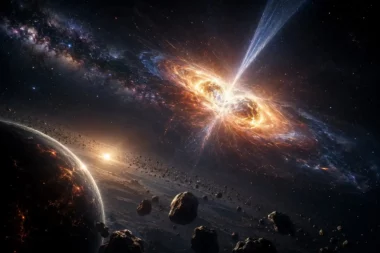
The merger of two neutron stars is among the most energetic and extreme events in the modern Universe.
Within an extraordinarily short period of time, neutron-rich material is ejected into space.
Ideal conditions for the r-process emerge.
In mere moments, enormous quantities of heavy atomic nuclei can form.
Including gold.
In 2017, humanity obtained one of the most compelling observational confirmations of this picture.
On 17 August 2017, the LIGO and Virgo detectors registered gravitational waves from an event designated GW170817.
Almost simultaneously, astronomical observatories around the world began detecting electromagnetic radiation from the same cosmic event.
It was the merger of two neutron stars.
Subsequent observations of the resulting kilonova revealed spectral and photometric signatures consistent with the production of large quantities of heavy elements through the r-process.
For the first time, humanity was effectively able to detect the gravitational signal of a cosmic collision while simultaneously observing an environment in which heavy elements were being created.
We had witnessed one of the mechanisms capable of producing the matter from which gold is made.
But the Story Is More Complex Than a Single Source
Modern astrophysics continues to refine its understanding of the relative contributions made by different cosmic processes to the formation of heavy elements.
Neutron-star mergers are among the most convincingly demonstrated and efficient sources of r-process elements.
Other potential sources, however, remain under investigation, including certain rare forms of massive-star collapse and the extreme explosive phenomena associated with them.
It is therefore scientifically more accurate to speak not of a single cosmic source responsible for all gold, but of a class of rare astrophysical events capable of generating the conditions required for an intense r-process.
The fundamental conclusion, however, remains unchanged.
Gold is not a product of ordinary terrestrial geology.
Earth did not create the gold atoms that we mine today.
It inherited them.
A Journey Through the Galaxy
The story did not end when the heavy elements were created.
Matter expelled into space during catastrophic astrophysical events mixed with interstellar gas and dust.
Millions of years passed.
Then hundreds of millions.
Some stars were born.
Others died.
Each generation of stars gradually enriched the interstellar medium with new chemical elements.
Gold atoms became part of immense clouds of matter moving through the Galaxy.
Approximately 4.6 billion years ago, one such enriched cloud began to collapse under its own gravity.
A young Sun formed at its center.
Around it emerged a protoplanetary disk.
From the material within that disk, the planets gradually formed.
Among them was Earth.
Gold was already present in the primordial material.
By the time Earth came into existence, gold was already ancient.
The Young Earth and the Disappearance of Gold
This raises another question.
If gold was present in the material from which Earth formed, why is it so rare in the Earth’s crust?
The answer lies in the early history of our planet.
The young Earth was extraordinarily hot.
A substantial portion of its material existed in a molten state.
Planetary differentiation began.
Dense elements and metals were redistributed within the planet.
Iron and other dense components migrated inward, gradually forming Earth’s metallic core.
Gold is a siderophile element: under conditions of planetary differentiation, it exhibits a strong chemical affinity for metallic iron.
As a result, a substantial proportion of Earth’s primordial gold followed iron deep into the young planet.
According to modern geochemical models, the overwhelming majority of Earth’s total gold inventory is thought to reside not in the accessible crust but deep within the planet, particularly in its core.
The gold mined by humanity today therefore represents only an exceedingly small accessible fraction of the planet’s total inventory.
How Gold Returned to the Accessible Earth
The story did not end with the formation of the core.
The early Solar System remained dynamic and unstable.
Earth continued to receive material from asteroids and other small bodies.
According to the late veneer, or late accretion, model, some of the siderophile elements found in the mantle and crust may have been delivered after the principal phase of core formation had already ended.
This material could no longer be completely drawn into the planet’s metallic core along with iron.
Some gold remained in the mantle and later became accessible within the crust through geological processes.
An important distinction must be made, however.
Gold did not remain in ready-made deposits from the moment ancient asteroids struck Earth.
Over the billions of years that followed, geological processes redistributed and concentrated it.
Hot hydrothermal fluids transported dissolved metals through fractures in the rock.
Changes in temperature, pressure, and fluid chemistry caused gold to precipitate.
Tectonic processes deformed and uplifted rocks.
Erosion broke down ancient deposits and transported particles of gold into river systems.
Through these processes, ore bodies and placer deposits emerged, waiting billions of years to be discovered by human beings.
A gold mine is therefore the final point in an extraordinarily long sequence of events.
Astrophysics created the atom.
The formation of the Solar System brought it to Earth.
Planetary differentiation determined its initial fate.
Cosmic accretion replenished part of the accessible inventory.
Geology concentrated it over billions of years.
Only then did humanity appear.
Why Ordinary Industry Cannot “Create” Gold
Modern civilization is capable of producing materials of extraordinary complexity.
We manufacture semiconductors with structures measured in nanometers.
We synthesize new molecules.
We engineer artificial crystals.
We alter the properties of matter at nearly the atomic scale.
But chemistry cannot transform one element into gold.
Chemical reactions alter the electron configurations surrounding atomic nuclei.
To create gold from another element, the atomic nucleus itself must be changed.
That is the domain of nuclear physics.
Technically, nuclear transmutation can produce individual gold atoms or extremely small quantities of gold from other elements through certain nuclear reactions.
But the energy and economic costs of doing so vastly exceed the value of the metal produced.
Thus, on any economically meaningful scale, humanity does not manufacture gold.
We merely discover, extract, refine, recycle, and relocate atoms that nature created long before human beings existed.
That distinction is fundamental.
Gold as a Finite Planetary Resource
An important economic consequence follows.
Gold is a finite resource not because humanity has imposed a limit on its supply.
That limitation arose at astrophysical and planetary scales long before economics existed.
We can increase expenditure on mineral exploration.
We can develop deeper deposits.
We can improve metallurgical technologies.
We can recycle electronic waste.
We can extract gold from ores containing progressively lower concentrations of the metal.
But all of these processes merely redistribute matter that already exists.
They do not create new gold atoms in economically significant quantities.
This is one of the fundamental distinctions between gold and most products of the human economy.
Its supply is constrained neither by legislation, nor by a central bank, nor by an algorithm.
It is constrained by the history of the Universe.
One Atom and Billions of Years of History
Consider a single gold atom in a modern bullion bar.
We cannot reconstruct its individual history.
But the physically possible sequence of events is remarkable in its scale.
At some distant point in the past, the matter from which it formed existed in an entirely different region of the Galaxy.
Then an extreme astrophysical event occurred.
A heavy atomic nucleus was created.
It was expelled into interstellar space.
Later, it became incorporated into the material from which the Solar System formed.
It arrived on the young Earth.
It survived billions of years of geological evolution.
It may have been transported by hydrothermal fluids.
It may have become embedded in rock.
It may have been liberated by erosion.
It may have accumulated within a mineral deposit.
Eventually, it was discovered by human beings.
Then extracted.
Smelted.
Refined.
And finally incorporated into a bullion bar, an electronic microchip, a spacecraft, or a ring worn on a human hand.
For a human being, such an object may exist for only a few decades.
For a gold atom, the entirety of human history is almost an instant.
From Cosmic Matter to Human Value
Here we encounter a particularly fascinating connection between physics and economics.
The Universe created gold without any concept of value.
To the cosmos, an atom of gold is no more expensive than an atom of iron.
Price emerged much later.
Human beings created it.
But humanity did not create the properties that made gold valuable.
Rarity.
Chemical stability.
High density.
Malleability.
Electrical conductivity.
Resistance to corrosion.
The limited availability of accessible supply.
All of these characteristics existed long before markets emerged.
Civilization merely discovered them and gradually constructed an economic system of trust around them.
The history of gold therefore represents an extraordinary intersection of two entirely different timescales.
The physical history of the metal is measured in billions of years.
The economic history of gold is measured in millennia.
Modern financial history is measured in decades.
And its market price changes every second.
Yet the underlying object remains the same.
Conclusion. A Metal Older Than Our World
We are accustomed to viewing gold through the lens of human history.
Pharaohs.
Ancient empires.
Coins.
The gold standard.
Central banks.
Financial markets.
Investment funds.
Electronics.
Space technology.
Yet all of these represent only the latest, extraordinarily brief chapter in a vastly older story.
Before states existed, gold already existed.
Before human beings existed, gold already existed.
Before Earth existed, atoms of gold could already have existed.
And before the Sun itself was born, earlier generations of stars and extreme cosmic events were already creating the heavy elements that would one day become part of our planet.
A gold bar, therefore, is more than concentrated economic value.
It is a material fragment of cosmic history.
Human beings can change its form.
Assign it a price.
Place it inside a bank vault.
Use it in a microprocessor.
Send it into space.
Melt it down a thousand times.
But a gold atom remains a gold atom.
And perhaps this is where the most remarkable characteristic of this metal can be found.
For thousands of years, humanity has used gold as a means of preserving value.
Yet gold itself was preserving something long before the concept of value existed.
It was preserving material continuity across cosmic time.
Every atom of gold touched by a human hand today is part of matter whose history began long before our civilization and, in many cases, long before the birth of Earth itself.
We call it a precious metal.
But from the perspective of the history of the Universe, gold is something even more extraordinary.
It is ancient cosmic matter that has survived a journey from the birth of heavy elements among the stars to the human hand.
MACKGOLD | OBSIDIAN CIRCLE
Department of Strategic Geopolitics and Natural Resources
15 August 2026