
 MACKGOLD | OBSIDIAN CIRCLE
Department of Strategic Geopolitics and Natural Resources
Why Scarcity Alone Does Not Create Value
Publication Date: August 1, 2026
Introduction. The Most Common Economic Misconception
One of the most widespread explanations for gold’s high value is the claim that its worth is determined solely by the limited quantity of its natural reserves.
This explanation appears in economics textbooks, market analyses, investment commentaries, and the financial media. It seems so self-evident that it is rarely subjected to serious critical examination.
A closer analysis, however, reveals that scarcity alone has never been sufficient to create lasting economic value.
The universe contains chemical elements and materials that are significantly rarer than gold.
Earth itself is home to thousands of exceptionally rare minerals that possess virtually no market value.
At the same time, there are resources whose global reserves are abundant, yet modern civilization could not function without them.
Scarcity and value, therefore, cannot be treated as interchangeable concepts.
Scarcity represents only one component of a far more complex system through which value is created.
Understanding this system explains why gold has maintained its exceptional economic role for several thousand years.
Scarcity Without Utility Does Not Create Value
Economic history demonstrates that countless exceptionally rare objects have never become universal stores of wealth.
A rare mineral may exist in only a single geological deposit.
A unique crystal may be the only specimen of its kind.
Certain chemical elements can be produced only under laboratory conditions and only in microscopic quantities.
Yet the overwhelming majority of such objects never become meaningful economic assets.
The reason is straightforward.
Scarcity alone does not answer the fundamental economic question.
What purpose does this object serve for society?
Value arises only when limited supply is combined with sustained human demand.
It is the interaction between supply and demand that transforms physical scarcity into economic value.
Without practical utility, scarcity remains merely a scientific fact.
It does not create economic value.
Why Gold Became Exceptional
Gold’s historical role emerged through an extraordinarily rare combination of physical, chemical, and economic characteristics.
The importance lies not in any single property by itself.
What proved decisive was the simultaneous presence of all these qualities within a single naturally occurring material.
Gold exists in limited natural quantities.
It is highly resistant to corrosion.
It can be divided into standardized units with ease.
It concentrates substantial value within a relatively small volume.
It is readily recognized across virtually every culture in the world.
It requires no complex storage conditions.
It cannot be manufactured artificially on an industrial scale while preserving its economic function.
Finally, over thousands of years humanity gradually developed enduring collective confidence in gold.
Many of these characteristics can also be found individually in other materials.
What remains virtually without parallel is their unique combination.
None of these properties would be sufficient on its own.
Together, however, they created the foundation for the unique economic role that gold continues to occupy today.
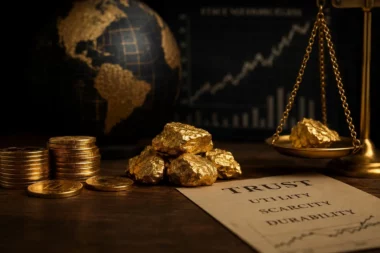
Trust as Accumulated Historical Capital
One of gold’s defining characteristics is that its value was not created overnight.
It evolved over thousands of years.
Each generation passed to the next not only the metal itself but also an understanding of its significance.
In this way, a unique form of historical capital was accumulated: trust.
This trust did not arise through political decree or legislative mandate.
It emerged from centuries of economic interaction among individuals, societies, and states.
Gold can therefore be viewed as one of the very few economic institutions that developed organically, without any central authority directing the process.
Such accumulated trust cannot be created by administrative decision.
It cannot be printed.
It cannot be reproduced within a few years.
This is precisely why gold continues to occupy a unique position even in the age of digital technologies.
Artificial Scarcity and Its Limits
Modern technology makes it possible to create artificially scarce assets.
Digital tokens.
Non-Fungible Tokens (NFTs), unique digital assets recorded on distributed ledger systems that cannot be exchanged on a one-to-one basis with one another.
Digital collectibles.
Limited-edition collections.
Other forms of programmable scarcity.
Yet a limited supply alone does not create fundamental value.
If society does not recognize an asset’s long-term utility, its scarcity remains merely a technical characteristic.
Financial history has repeatedly demonstrated that artificially created scarcity can sustain value only for as long as market participants continue to trust it.
Once that trust disappears, limited supply ceases to be the determining factor.
Long-term value depends not only on constrained supply but also on society’s willingness to maintain demand over extended periods of time.
Why Gold Differs from Most Assets
Most financial assets exist because they represent obligations.
Shares represent ownership interests in corporations.
Bonds are debt obligations issued by borrowers.
Bank deposits are liabilities owed by financial institutions to their depositors.
Even modern sovereign currencies ultimately rely on confidence in the institutions responsible for issuing and maintaining the monetary system.
Gold is fundamentally different.
It is nobody’s liability.
Its existence does not depend upon the financial condition of any government, bank, corporation, or other institution.
For this reason, during periods of economic and geopolitical uncertainty, gold continues to be regarded as an independent store of value.
The Economy of the Future Will Redefine Value
As technology advances, humanity will become increasingly capable of identifying the true constraints on global resources.
Energy will become even more important.
Fresh water.
Rare materials.
Computing capacity.
Advanced technological infrastructure.
Yet the fundamental principles governing value creation will remain unchanged.
The most valuable resources will not necessarily be the rarest.
They will be those that combine scarcity with practical necessity, long-term utility, and enduring public trust.
In this respect, gold remains one of the clearest examples of how fundamental economic value is formed.
Conclusion. Value Is Not Born from Scarcity Alone
The history of gold demonstrates that fundamental value never arises from a single characteristic or from scarcity alone.
It emerges when multiple independent factors reinforce one another.
Limited natural supply.
Physical durability.
Practical usefulness.
High liquidity.
Historically accumulated trust.
Universal global recognition.
It is the combination of these characteristics that makes gold a unique economic phenomenon.
The principal reason for gold’s enduring value is not merely the limited size of its natural reserves.
To this day, humanity has not identified another material that combines such an exceptional range of physical, economic, and historical characteristics within a single substance.
In this sense, gold represents far more than a precious metal.
It stands as one of history’s clearest demonstrations of how the fundamental properties of matter, the practical needs of society, collective trust, and centuries of economic evolution can converge to create one of the most resilient systems of value ever developed by human civilization.
MACKGOLD | OBSIDIAN CIRCLE
Department of Strategic Geopolitics and Natural Resources