
 MACKGOLD | OBSIDIAN CIRCLE
Department of Strategic Geopolitics and Natural Resources
Why Humanity Never Stops Returning to Gold
Publication Date: June 15, 2026
Introduction. The Paradox of Gold
Throughout human history, thousands of goods, resources, and technologies have acquired tremendous value and later disappeared from economic life.
Some materials were replaced by more efficient alternatives.
Others lost their importance as technologies evolved.
Still others were simply exhausted.
Yet there is one exception.
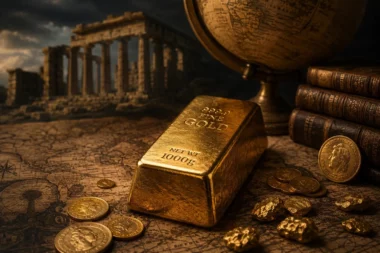
For more than five thousand years, gold has maintained a unique position within human civilization.
Empires disappeared.
Currencies collapsed.
States emerged and dissolved.
But gold continued to pass from one generation to the next.
This fact requires explanation.
Why did gold become one of the very few material objects capable of preserving its significance across millennia?
The answer is connected not only to economics.
It is connected to a fundamental property of irreversibility.
Economies of Consumption and Economies of Preservation
Most resources exist to be consumed.
Oil is burned.
Natural gas is used as an energy source.
Coal is converted into heat.
Wheat becomes food.
Timber becomes construction material.
After use, a substantial portion of the resource ceases to exist as an independent object.
The economy is built around a continuous process of transforming matter.
Gold occupies the opposite position.
The overwhelming majority of all gold ever mined by humanity still exists in physical form.
It may change owners, shape, or storage location, but it rarely disappears from the system.
This makes gold unique among the major resources of the global economy.
The Physical Durability of Gold
The reason for this characteristic lies in the properties of gold itself.
The metal is remarkably resistant to corrosion.
It does not oxidize under normal conditions.
It is not destroyed by water.
It does not react with most substances found in the natural environment.
An object made of gold can survive for centuries with little or no significant alteration.
Archaeological discoveries have demonstrated this throughout human history.
Gold artifacts created thousands of years ago continue to retain their recognizable form and chemical structure.
From a physical perspective, gold is among the most stable metals ever used by humanity.
Gold as a Material with Minimal Losses
In most production cycles, part of a resource is permanently lost.
Metals wear down.
Structures deteriorate.
Materials disperse into the environment.
Gold differs through its exceptionally low level of irreversible loss.
Even after industrial use, the metal can often be recovered and returned to circulation.
Jewelry can be melted down.
Coins can become bullion.
Industrial residues can be recycled.
As a result, humanity’s total stock of gold has grown almost continuously.
Each new generation gains access not only to current mining production but also to a substantial portion of the metal accumulated by previous generations.
The Memory of the Economy
There exists a special form of memory that is not associated with books, archives, or digital storage systems.
It is material memory.
A gold bar contains no text.
It stores no images.
It does not transmit information directly.
Yet it embodies information about accumulated labor, resources, and time.
In this sense, gold becomes a unique container of economic memory.
The metal is capable of connecting different eras.
Some of the gold stored today in central bank vaults may have existed long before the emergence of modern states.
Very few other assets possess a comparable characteristic.
Central Banks and the Logic of Long-Term Continuity
Modern financial systems are built on digital technologies.
Transactions are processed electronically.
Payments are completed within seconds.
Financial flows are measured in trillions of monetary units.
Nevertheless, central banks continue to hold gold.
The reason is not technological necessity.
The reason is the time horizon.
Most financial instruments represent obligations.
A bond is an obligation of an issuer.
A bank deposit is an obligation of a bank.
A currency is an obligation of a state.
Gold is not an obligation.
It exists independently of the condition of any particular institutional system.
For this reason, over long periods of time, gold serves as a reserve element of stability.
Irreversibility and Trust
Trust is the foundation of every economy.
Yet trust rarely exists by itself.
It requires objects capable of surviving political cycles, technological transformations, and institutional change.
Gold has proven to be one of the very few material objects possessing such a characteristic.
Its value is not determined solely by industrial utility.
Its significance is linked to its ability to preserve its physical identity over extended periods of time.
This is the connection between irreversibility and trust.
The lower the probability that an object will disappear, the easier it becomes to use it as a store of value.
Conclusion. The Metal That Remains
Most resources exist to be transformed.
Gold exists to be preserved.
Most materials gradually disappear from the economic system through consumption, destruction, or dispersion.
Gold remains.
It is precisely this characteristic that has allowed it to perform a unique role for thousands of years.
Economic systems change.
Technologies change.
Forms of money change.
Yet the metal capable of preserving itself with minimal alteration continues to occupy a special place within the structure of human civilization.
Perhaps the primary reason for the resilience of gold is neither its rarity nor its beauty.
It is that among the many resources of Earth, gold has proven to be one of the very few materials capable of almost never disappearing from history.
MACKGOLD | OBSIDIAN CIRCLE
Department of Strategic Geopolitics and Natural Resources
June 15, 2026