
 Publication date: January 15, 2026
Published by
MACKGOLD | OBSIDIAN CIRCLE
Department of Strategic Geopolitics and Natural Resources
mackgold.com
Introduction. The paradox of terrestrial gold
If we consider Earth as a physical system governed by the laws of planetary differentiation, the presence of gold in the Earth’s crust in quantities sufficient to form deposits requires explanation.
Gold belongs to the group of highly siderophile elements. During planetary formation, these elements exhibit a strong affinity for metallic phases and, in the presence of molten iron, should concentrate in the core. Within basic geochemical models, this means that after core formation is complete, the mantle and crust should be almost completely depleted of gold.
Empirical data show otherwise. The concentration of gold and platinum-group elements in Earth’s mantle and crust is significantly higher than calculated values for a fully differentiated planet. This discrepancy is not a statistical error. It is consistently reproduced in independent measurements and has become the foundation for the concept of late accretion.
This leads to a fundamental question of resource ontology: why did Earth end up sufficiently enriched in noble metals to enable the emergence of the financial and technological infrastructure of civilization?
Modern planetary geochemistry provides an answer based not on speculation but on a body of observable facts. A significant portion of the noble metals accessible in Earth’s crust is linked not only to internal planetary processes but also to an external source. This conclusion is based on the logic of planetary differentiation, data from lunar samples, asteroid material, and isotopic geochemistry.
The Moon as an archive of the early Solar System
Earth is a geologically active planet. Plate tectonics, erosion, sedimentary cycles, the hydrosphere, and the biosphere constantly rework surface and near-surface layers. As a result, primary traces of the planet’s early history are preserved only fragmentarily.
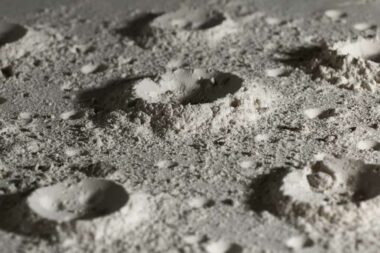
The Moon is fundamentally different. The absence of an atmosphere, oceans, and tectonics makes its surface layers a long-term archive of the Solar System’s impact history. Lunar regolith forms through billions of years of rock fragmentation and the continuous addition of extraterrestrial material.
Meteorites and micrometeorites have systematically added material containing platinum-group elements and gold to the lunar surface. This is reflected in the chemical composition of the regolith, especially in impact melt deposits.
Analysis of samples returned by the Apollo missions showed that noble metal concentrations in lunar soil correlate with the contribution of meteoritic material rather than with the Moon’s internal differentiation. Later studies refined this conclusion, showing that the greatest potential for siderophile element concentration is associated with impact melts, where localized fractional concentration is possible.
The Moon is not a direct model for Earth. However, its geological passivity allows isolation of the exogenous factor without the influence of tectonics and hydrothermal processes. In this role, the Moon acts as an objective geochemical record documenting the fundamental possibility of impact delivery of noble metals to planetary surfaces.
Late accretion and Earth’s material asymmetry
The late accretion hypothesis emerged as a response to the measurable mismatch between expected and observed abundances of highly siderophile elements in Earth’s mantle. Modern estimates show that after core formation, Earth received an additional mass amounting to fractions of a percent of its total mass.
This addition was small in mass but significant in composition. It delivered elements that otherwise would have been almost completely isolated in the core. In this context, gold passes through two fundamental filters.
The first filter is planetary. During early formation, most gold sinks into the core together with iron.
The second filter is cosmic. After differentiation is complete, the planet receives additional material enriched in noble metals.
After that, a third, strictly terrestrial level activates. Tectonics, magmatism, and hydrothermal fluids rework the dispersed material, forming local concentrations that become ore deposits.
Each gold deposit thus carries traces of both deep planetary processes and rare events from the late history of the Solar System.
Scientific literature continues to debate the details of the late veneer’s composition and the mechanisms of elemental redistribution. These refinements do not negate the main conclusion: Earth’s crust contains a measurable imprint of cosmic history.
Asteroids as control samples of matter
If the Moon is an archive of impact processes, asteroids represent an archive of primordial material. Their value lies in preserving the primary mineralogical and isotopic characteristics of the early Solar System.
Samples returned from asteroids Ryugu and Bennu allow the study of phases in which siderophile elements concentrate, including sulfides and metallic inclusions. These data serve as reference points for interpreting terrestrial and lunar materials.
It is crucial to distinguish between the scientific value of asteroid material and hypothetical scenarios of commercial mining. The content of noble metals in asteroids varies significantly depending on the type of body, and estimates of large-scale reserves often ignore mineralogical, energetic, and technological constraints.
For strategic analysis, the key conclusion is different. Asteroids are not a shortcut to cheap gold. They are a reference source for understanding the origin of noble metals in planetary systems.
Gold as a factor of stability
In economics, gold functions as an anchor of trust. In geology, it is a trace of rare processes. These two levels are causally connected.
The amount of gold available on Earth’s surface is not arbitrary. It is determined by a chain of events that includes early differentiation, late accretion, and subsequent geodynamics. This chain cannot be reproduced on the scale of human history.
Gold differs from most other resources not only in rarity but also in origin. It is the result of processes that cannot be accelerated, replaced, or technologically recreated. This is the basis of its fundamental asymmetry.
The Moon records the reality of impact delivery of material. Asteroids provide control samples of primordial matter. Earth integrates these factors, turning cosmic heritage into the foundation of economic stability.
Conclusion. Gold as a metal of depth and a metal of space
The history of gold on Earth represents a dual protocol.
The first protocol is deep. During planetary formation, the core removes most siderophile elements.
The second protocol is cosmic. Late impacts return part of the noble metals to the mantle and crust system.
As a result, gold ceases to be only a metal of value. It becomes material evidence that the stability of civilization rests on events that occurred long before its emergence and partly beyond Earth itself.
The topic of gold beyond Earth is not exotic speculation but strict analysis of the sources of stability. In the 21st century, when resources once again become the language of politics, turning to the origin of matter means turning to the limits of reproducibility of the very system of trust.
Authors
MACKGOLD | OBSIDIAN CIRCLE
Department of Strategic Geopolitics and Natural Resources