
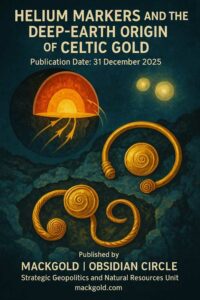
 Publication Date: 31 December 2025
Published by
MACKGOLD | OBSIDIAN CIRCLE
Strategic Geopolitics and Natural Resources Unit
mackgold.com
Introduction: Gold as a Signal of Deep-Earth Processes
Gold has traditionally been viewed as a product of crustal geological processes — the result of material redistribution in the upper layers of the Earth’s crust under the influence of tectonics, heat and fluids. However, recent research points to a deeper, mantle-derived origin of this metal, linked to processes occurring far below the surface of the planet.
At the end of 2025, a research team led by Professor Fin Stuart of the University of Glasgow presented results that make a fundamental contribution to the understanding of the genesis of gold deposits in the British Isles. Using high-precision mass-spectrometric analysis of gases trapped in minerals for hundreds of millions of years, the researchers demonstrated that the gold of the Caledonian orogenic belt is associated with deep mantle processes.
The Caledonian Belt: Geology of Continental Collision
The Caledonian mountain belt formed approximately 490–390 million years ago as a result of the collision of the continental plates of Laurentia, Baltica and Avalonia. This tectonic zone, extending for about 1,800 kilometres, runs from the Appalachian Mountains in North America through Scotland and Ireland to northern Norway.
For decades, geologists have debated the origin of major gold systems in such orogenic belts. One hypothesis attributed their formation to melting of crustal rocks, while another emphasized the circulation of hot fluids released during heating and deformation of the crust in tectonic events.
The new study proposes a more fundamental level of explanation, shifting the focus from surface-level mechanisms to deep sources of matter and energy.
Helium as a Marker of Deep Origin
The research team analysed gold-bearing sulphide minerals from deposits within the Caledonian belt using mass spectrometers at the Scottish Universities Environmental Research Centre (SUERC). The key focus was on trace amounts of helium trapped in the minerals at the time of their formation.
The results showed that the isotopic composition of helium in all examined samples — regardless of the size or age of the deposit — corresponds to a mantle source. This indicates that both the helium and the thermal energy required to drive the circulation of gold-rich fluids originated in the deep Earth.
Gold, therefore, was not merely redistributed within the crust, but became part of a geochemical cycle initiated by mantle melting beneath colliding tectonic plates.
Deposit Size and Depth of Source
The researchers identified a correlation between the proportion of deep-sourced helium, the temperature of mineralising fluids and the scale of gold systems. The greater the contribution of mantle helium, the larger and more energetically powerful the deposit.
This observation has direct practical significance. As noted by lead author Dr Calum Lyell, an exploration geologist at Western Gold Exploration, helium isotopes may serve as a universal geochemical indicator for identifying large mineral systems.
Helium thus emerges not merely as an inert gas, but as an informational carrier of deep-Earth processes, enabling assessment of deposit potential at an early exploration stage.
Implications for Global Geology and Resource Strategy
The conclusion that Caledonian gold has a deep mantle origin carries broader implications. It suggests that key metals of civilization may be linked to deep thermal and geochemical fluxes, rather than being products of surface crustal processes alone.
For strategic geology, this represents a shift from describing outcomes to understanding sources. Deep geochemical signals may become a new navigational tool as traditional surface resources approach exhaustion.
Professor Fin Stuart emphasized that the presence of mantle-derived helium in all studied deposits is clear evidence of the essential role of mantle melting in forming this globally significant type of gold system. Whether this mechanism also applies to other technology-critical metals remains an open question.
Conclusion: Gold as a Product of Depth
Gold is commonly perceived as a surface metal — mined, processed and applied in technology. The results from the Caledonian belt, however, indicate that its true origin may lie in processes operating at the deepest levels of planetary dynamics.
This discovery not only resolves a long-standing scientific debate, but also expands the philosophy of resources. Gold once again confirms its role not merely as an economic asset, but as a material trace of fundamental Earth processes.
In this sense, the study of the deep-Earth origin of gold becomes a symbolic closing note of a year in which questions of sustainability, sources and limits returned to the centre of global attention.
Authors
MACKGOLD | OBSIDIAN CIRCLE
Strategic Geopolitics and Natural Resources Unit