
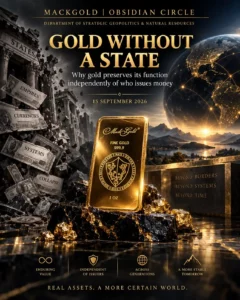
 MACKGOLD | OBSIDIAN CIRCLE
Department of Strategic Geopolitics and Natural Resources
Why Gold Retains Its Function Regardless of Who Issues the Money
Publication Date: September 15, 2026
Introduction.
Who Stands Behind Value
Almost every financial asset is tied to someone else’s obligation.
A bank deposit presupposes the existence of a bank.
A bond presupposes the existence of an issuer and its ability to fulfill its promise.
A banknote exists within the monetary system of a state.
Cashless money requires banking and payment infrastructure.
Digital financial instruments require functioning networks, software, access rules, and mechanisms for verifying ownership.
The modern economy is built on an extraordinarily complex architecture of mutual obligations.
Gold occupies an unusual place within this architecture.
A physical gold bar is not a promise to pay its owner anything in the future.
It does not represent the debt of a state.
It is not a liability of a bank.
It does not require a corporation to redeem its face value.
It has no issuer that must fulfill a contract.
If physical gold is held directly and is not encumbered by third-party claims, its existence does not depend on the solvency of another participant in the financial system.
That is why the question of gold goes far deeper than the question of its price.
What does it mean for an asset to be capable of moving between different monetary systems without fully belonging to any one of them?
Money Is an Institution
Modern money cannot be understood merely as paper, metal, or digits on a screen.
Money is first and foremost an institution.
For a national currency to function, there must be a state, a legal system, a central bank, a commercial banking system, payment infrastructure, mechanisms for enforcing contracts, and public trust.
This is not a weakness.
It is precisely the institutional nature of money that allows the modern economy to exist at its current scale.
Fiat currency makes it possible to settle transactions among millions of participants.
The banking system creates credit.
Central banks manage monetary conditions.
Financial markets allocate capital.
The state collects taxes and carries out expenditures.
Gold cannot replace this entire mechanism. Nor should it.
The mistake begins when gold and modern currency are treated as two versions of the same instrument.
They perform different functions.
Currency is designed primarily to facilitate the movement of the economy.
Gold has historically proved exceptionally well suited to preserving value and serving a reserve function over long periods of time.
Currency Exists Within a System
Every state currency has a jurisdiction.
The dollar is tied to the monetary system of the United States.
The euro is tied to the institutional architecture of the euro area.
The pound sterling is tied to the British monetary system.
The yen is tied to the Japanese monetary system.
Behind every currency stands a specific set of institutions.
This gives a currency strength.
But it also creates dependence.
Changes in interest rates affect its value.
Monetary issuance affects purchasing power.
Fiscal policy affects confidence.
Political decisions can affect capital flows and the conditions under which financial infrastructure may be used.
A currency does not exist separately from the state and the institutions that organize its circulation.
Gold is structured differently.
Gold has no nationality.
An atom of gold does not become American, European, Swiss, or Singaporean simply because it crosses a national border.
The legal status of ownership may change.
The tax regime may change.
Its price in national currency may change.
But the physical properties of the metal remain the same.
An Asset Without an Issuer
This distinction becomes especially clear when gold is compared with debt instruments.
A bond represents a promise.
One participant in the financial system provides capital to another and receives a claim on future payments.
The quality of such an asset is therefore linked to the quality of the obligation.
How reliable is the issuer?
Can it service its debt?
In what currency will repayment be made?
How will the purchasing power of that currency change?
What legal conditions govern the obligation?
Gold is structured differently.
A gold bar does not promise a future cash flow.
It pays no coupon.
It accrues no interest.
This is often described as a disadvantage.
But the same property has another side.
If there is no promised payment, there is no issuer that can fail to make that payment.
In financial terminology, directly held physical gold is regarded as an asset without issuer credit risk.
This does not mean that it is free of all risk.
There is price risk, storage risk, theft, counterfeiting, liquidity constraints under certain conditions, legal restrictions, and operational risks.
But these are risks of a different kind.
There is no credit promise embedded within the atom of gold itself.
Counterparty Risk and Physical Ownership
An important distinction must be made here.
Not every economic position linked to gold has the same characteristics.
A gold futures contract is not the same as a physical bar.
A share in a fund linked to gold is not identical to direct ownership of the metal.
A bank claim on gold may involve the risk of a financial intermediary.
A derivative represents a contractual relationship between participants.
Therefore, the statement that gold carries no issuer credit risk applies primarily to physical gold held in direct ownership and not constituting someone else’s debt obligation.
This distinction is fundamental.
The financial system can create many instruments around gold.
But those instruments can reintroduce the very counterparty risk from which physical metal is structurally different.
Gold and a financial claim on gold are not always the same economic phenomenon.
Empires Disappear Faster Than Metals
The history of money is a history of constant institutional change.
States have emerged and disappeared.
Empires have expanded and collapsed.
Monetary units have been reformed.
Coinage standards have changed.
Paper currencies have appeared, depreciated, been replaced, or merged.
But gold has repeatedly passed from one political system into another.
Roman gold did not cease to be gold after the fall of the Western Roman Empire.
Metal belonging to one dynasty could later end up in the treasury of another.
Coins were melted down.
Bars changed form.
Jewelry became monetary metal, and monetary metal became jewelry again.
Political affiliation changed.
Its physical nature remained.
This creates an unusual asymmetry of time.
The lifespan of a particular monetary system may be measured in decades or centuries.
The history of gold itself as a material carrier of value extends across many such systems.
Gold Outlives Its Own Monetary Forms
Even the role of gold itself has constantly changed.
At one time, it was used directly as money.
Then it became the foundation of coinage systems.
Later, it became part of the gold standard, under which monetary obligations were linked to a defined quantity of the metal.
In the twentieth century, the international monetary architecture changed again.
After the Second World War, the Bretton Woods system linked many currencies to the U.S. dollar, while the dollar itself was linked to gold for official international transactions at a fixed price.
In August 1971, the United States ended the convertibility of the dollar into gold for foreign official holders.
The subsequent transformation of the international monetary system ultimately separated today’s major currencies from the old gold link.
One might have expected gold to gradually disappear from the architecture of state reserves after that.
But it did not.
Gold ceased to be the foundation of the old monetary system.
Yet it did not cease to be a reserve asset.
This distinction is extremely important.
The Central Bank Paradox
A modern central bank has capabilities that did not exist for the financial institutions of the ancient world.
It participates in the creation of the monetary base.
It manages interest rates or other monetary conditions within the framework of its mandate.
It provides liquidity to the financial system.
It manages international reserves.
And yet many central banks continue to hold gold.
At first glance, this appears paradoxical.
Why would an institution at the center of a modern fiat monetary system hold a metal that is no longer a required foundation for issuing currency?
The answer lies in the nature of reserves.
A reserve portfolio does not have to consist only of assets that are maximally convenient for everyday transactions.
It must take into account liquidity, safety, diversification, currency risks, and resilience under different scenarios.
Gold adds a distinctive feature to this architecture.
It is not a debt obligation of a foreign government.
That is precisely what makes it fundamentally different from government bonds, bank deposits, and other financial claims.
Reserves and Trust Are Not the Same Thing
The presence of gold in reserves is sometimes interpreted as an expression of distrust toward modern currencies.
That is an overly simplistic explanation.
Central banks can hold gold, foreign currency, government securities, and other reserve assets at the same time.
These instruments do not necessarily exclude one another.
They serve different purposes.
Diversification itself is one of the key principles of reserve architecture.
Gold does not have to replace foreign exchange reserves in order to make sense.
Its function may lie precisely in the fact that it behaves differently.
If an entire reserve consists of obligations issued by other participants in the financial system, it is fully dependent on the corresponding issuers, intermediaries, and institutions.
Adding an asset with no issuer changes the structure of risk.
Gold should therefore be viewed not as a rejection of the modern monetary system.
More accurately, it is an element that exists alongside it.
A State Can Determine Gold’s Price in Its Currency, but Not the Nature of the Metal
States can exert an enormous influence on the economic life of gold.
They can establish trading rules.
Tax transactions.
Set import and export requirements.
Regulate financial products.
Shape reserve policy.
In certain historical periods, states imposed far stricter restrictions on the ownership and circulation of gold.
It would therefore be incorrect to claim that gold exists “outside the state” in a legal sense.
Property always exists within a particular legal order.
But there is a deeper level.
The state regulates a person’s relationship with gold. It does not create gold’s physical properties.
It can change a tax rate.
But not atomic number 79.
It can change the currency price of an ounce.
But not the metal’s chemical stability.
It can change trading rules.
But it cannot create new gold by decision of a central bank.
It is in this sense that gold possesses a form of independence that financial instruments do not.
The Price of Gold and the Value of Gold Are Different Categories
The price of gold is always expressed in terms of something else.
Dollars per ounce.
Euros per kilogram.
Yen per gram.
But if the price of gold changes in a particular currency, that does not necessarily mean that only the valuation of gold itself has changed.
The unit in which that price is expressed may also have changed.
This is a fundamental problem with any nominal price.
When gold rises in price in a given currency, there may be several reasons:
changes in demand for the metal; changes in real interest rates; inflation expectations; currency fluctuations; geopolitical risk; changes in reserve policy; changes in confidence in financial assets.
Gold is therefore both a commodity and an object of monetary measurement.
It is this dual nature that makes it unusual.
We measure gold in money. But throughout history, people have repeatedly used gold to evaluate money itself.
When the Unit of Measurement Changes
Imagine an asset whose price has risen substantially over decades in a particular currency.
Intuitively, it seems that the asset has become more expensive.
But economic analysis requires a second question:
what happened to the currency itself during that time?
If its purchasing power declined, part of the nominal increase in the asset’s price may reflect not only a change in the market valuation of the asset itself, but also a change in the monetary unit used to measure it.
For gold, this question is especially interesting because its physical unit is exceptionally stable.
One troy ounce remains one troy ounce.
What changes is the number of currency units required to acquire it.
And for this reason, the long-term history of the gold price is also part of the history of currencies themselves.
Sovereignty and Reserves
For a state, a reserve is not an ordinary investment portfolio.
Its purpose is much broader.
A reserve may be needed to ensure external payments, support confidence, manage crises, and preserve financial stability.
That is why return is only one of the relevant parameters.
No less important is the question:
who does the asset depend on?
This is where gold acquires a strategic dimension.
A bond depends on its issuer. A deposit depends on a bank.
A currency depends on a monetary system.
Physical gold depends primarily on the ability to own it securely, store it, and exchange it when necessary.
This does not make gold absolutely independent.
But it reduces the number of institutional layers between the owner and the asset itself.
In reserve architecture, that characteristic may matter precisely because it differs from the properties of other reserve instruments.
The Digital Age Does Not Eliminate This Question
The modern financial system is becoming increasingly digital.
Payments are accelerating.
Assets are being tokenized.
Settlements are being automated.
Financial data moves almost instantaneously.
In the future, monetary infrastructure may become even more technologically advanced.
But digitalization does not eliminate the fundamental question of counterparty risk.
It merely changes its form.
Behind a digital asset there may still be an issuer, software protocol, custodian, network, legal framework, or infrastructure.
The more complex the financial system becomes, the more layers of interdependence emerge.
This is precisely why the existence of a physical asset without an issuer does not become less interesting in the digital age.
Perhaps the opposite is true.
The more abstract the form of money becomes, the more visible the distinction of an object whose value is not a record of someone else’s obligation.
But Gold Also Requires Trust
Here, another oversimplification must be avoided.
It is sometimes said that gold requires no trust.
That is incorrect.
The market value of gold also exists because of human recognition.
For gold to perform a reserve function, people and institutions must continue to regard it as valuable, liquid, and acceptable as an object of exchange.
There must be trust in the purity of the bar.
The refining system.
The vault.
The weight.
The provenance.
The ownership rights.
The market in which the metal can be sold.
Therefore, gold does not exist outside trust.
Its distinguishing feature lies elsewhere.
Trust is directed not toward an issuer’s promise to deliver something in the future, but toward the properties of the asset itself and toward the long-established system of recognition surrounding it.
This is a fundamentally different type of trust.
Two Architectures of Trust
Thus, the modern financial system demonstrates two different models.
The first is institutional trust.
We accept currency because there is a state, a legal system, a central bank, a tax system, an economy, and a payment infrastructure.
The second is trust in an asset historically recognized independently of any specific issuer.
Gold belongs predominantly to the second category.
One model does not eliminate the other.
Modern civilization requires institutional money.
Without it, credit, mass payments, modern public finance, financial markets, and a complex global economy would be impossible to imagine.
But precisely because much of the system is built on mutual obligations, an asset of a different type can perform a special function.
Not to replace the system.
But to create an additional layer of resilience within it.
Gold Between Systems
In previous MACKGOLD | OBSIDIAN CIRCLE studies, we examined gold as a rare element, as a product of cosmic history, and as an enormous above-ground stock accumulated by humanity.
But there is another dimension.
Gold can move not only between owners.
It can move between monetary eras.
One currency replaces another.
States change.
Settlement regimes change.
Reserve standards change.
Technologies for storing and transferring value change.
Yet the metal can be remelted, standardized, and incorporated once again into a new economic system.
Gold therefore possesses an unusual form of institutional durability.
Not because it always performs the same function.
On the contrary.
Its functions are constantly changing.
It is precisely its ability to survive changes in functions and systems that makes it historically exceptional.
Conclusion.
An Asset That Needs No Issuer
The modern economy cannot exist without states, banks, credit, currencies, and financial markets.
Gold is not an alternative to this entire architecture.
It represents a different type of economic object.
Its fundamental distinction does not lie in its shine.
Not only in its rarity.
Not only in its history.
And not even only in its ability to endure for practically unlimited periods of time.
The principal distinction is structural.
Gold is not anyone’s promise.
For a bond to retain its value, the issuer must fulfill its obligations.
For a deposit to remain accessible, the banking system must continue to function.
For a currency to retain trust, the institutions supporting its circulation must remain intact.
For physical gold to remain gold, nothing is required from an issuer.
This does not make it risk-free.
It does not make it perfect money.
It does not guarantee price appreciation.
But it places gold in a distinct category of assets.
States create currencies.
Banks create credit.
Financial markets create countless forms of claims and obligations.
Technology creates ever-new ways of transferring value.
And gold passes through these systems without ultimately belonging to any one of them.
Perhaps this is why one of the most interesting paradoxes of the modern monetary system can be expressed as follows:
states possess the power to create money, yet they continue to hold a metal they cannot create.
Not because gold should replace money.
But because in a world of obligations, there is value in an asset that is not itself an obligation.
MACKGOLD | OBSIDIAN CIRCLE
Department of Strategic Geopolitics and Natural Resources
15 September 2026