
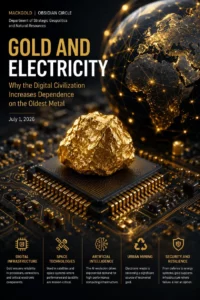
 MACKGOLD | OBSIDIAN CIRCLE
Department of Strategic Geopolitics and Natural Resources
Why Digital Civilization Is Increasing Its Dependence on the Oldest Metal
Publication Date: July 1, 2026
Introduction. The Paradox of the Digital Age
When most people think of gold, they usually picture bullion bars, coins, jewelry, or central bank vaults.
For thousands of years, gold has served as a symbol of wealth, power, and financial stability.
However, the twenty-first century is gradually revealing another side of this metal.
As digital civilization develops, gold is acquiring increasingly important technological significance.
A paradox emerges that would have seemed almost unimaginable only a few decades ago.
The more virtual the world becomes, the more dependent it is on a physical metal known to humanity since antiquity.
Artificial intelligence, cloud computing, data centers, satellite systems, global telecommunications networks, medical equipment, and advanced electronics all rely on properties of gold that remain practically irreplaceable.
The story of gold is no longer exclusively a story of the past.
It is becoming part of the infrastructure of the future.
Why Electricity Requires Special Materials
Every digital technology ultimately functions as a system for transmitting electrical signals.
Every message, bank transfer, video call, artificial intelligence query, or satellite data transmission exists because electrons move through an enormous number of electrical connections.
At first glance, it may appear that any conductive material could perform this task.
In practice, the requirements are far more demanding.
Modern electronics require materials that simultaneously provide high electrical conductivity, corrosion resistance, chemical stability, durability, and the ability to maintain performance over many years of operation.
Most metals satisfy only some of these requirements.
Gold belongs to a rare group of materials that combine all of them at once.
This is why its importance remains intact despite the constant development of new technologies.
A Unique Combination of Properties
In terms of electrical conductivity, silver outperforms gold.
Copper is significantly cheaper.
Aluminum is lighter.
Yet none of these metals can fully replace gold in the most critical systems.
The primary reason lies in its unique combination of characteristics.
Gold is remarkably resistant to oxidation.
Copper gradually develops an oxide layer.
Silver reacts chemically with its environment.
Gold remains stable even after decades of use.
Its contact surfaces retain their ability to transmit signals reliably without degradation.
For consumer electronics this may seem like a secondary consideration.
For a satellite worth hundreds of millions of dollars or a mission-critical computing facility, it becomes one of the key conditions for reliability.
Gold Inside the Digital World
Virtually every modern computer contains gold.
The amount of metal in a single device may be small, yet its presence is important.
Gold is used in processors, microchips, contact pads, connectors, network interfaces, and memory modules.
Its role is especially important wherever guaranteed signal reliability is required over many years.
Today the global economy relies on billions of electronic devices.
Even a small quantity of gold in each device translates into significant aggregate industrial demand.
As a result, gold becomes part of virtually every digital operation performed by modern society.
Urban Gold Deposits
Technological development has created a phenomenon that would have seemed unusual not long ago.
Increasing amounts of gold are now located not beneath the Earth’s surface but inside electronic equipment.
Old computers, smartphones, servers, telecommunications systems, and industrial electronics contain precious metal in various components.
For this reason, electronic waste recycling is gradually becoming a distinct global industry.
In some cases, the concentration of gold found in electronic scrap exceeds that of certain types of gold-bearing ore.
As the digital economy expands, the importance of these sources will continue to grow.
Humanity is effectively creating its own artificial gold deposits within urban infrastructure.
Artificial Intelligence and a New Wave of Demand
Artificial intelligence has become one of the most powerful drivers of technological change.
Modern AI models require enormous computational resources.
Their operation depends on specialized processors, high-speed data transmission systems, and new generations of server infrastructure.
Every element of this ecosystem depends on reliable electrical connections.
The more computing capacity that is deployed, the greater the demand for high-quality electronic components.
Gold itself does not create algorithms or train neural networks.
However, it helps provide the physical infrastructure within which modern artificial intelligence systems operate.
Data Centers as a New Industrial Ecosystem
A modern data center is one of the most complex engineering structures in the global economy.
Tens of thousands of servers operate around the clock.
Millions of connections transmit enormous volumes of information every day.
Every contact point must function with maximum reliability.
Even a brief failure can result in financial losses, disruption of critical services, and interruptions across global networks.
As new data centers are built, indirect industrial demand grows for materials that ensure the stability of the entire infrastructure.
Among those materials, gold occupies a unique position.
Space and the Limits of Reliability
The importance of gold becomes especially evident beyond Earth.
Spacecraft operate under vacuum conditions, radiation exposure, and extreme temperature fluctuations.
Once launched, most systems cannot be repaired.
For this reason, engineers rely on materials with highly predictable performance characteristics.
Gold is used in satellite electronics, communication systems, electrical contacts, and protective coatings.
Its use is driven not by prestige but by the necessity of ensuring long-term equipment reliability.
In the space sector, the cost of failure greatly exceeds the cost of the metal itself.
Military and Critical Systems
The same logic applies to aviation, energy infrastructure, and defense industries.
Air traffic control systems.
Radar installations.
Military communications equipment.
Power networks.
Critical infrastructure facilities.
In all these sectors, the consequences of technical failure can be extremely serious.
As a result, engineers continue to use materials that have demonstrated reliability over decades of operation.
Gold remains one of those materials.
Can Gold Be Replaced?
The search for alternatives is ongoing.
The cost of gold creates an obvious incentive to replace it.
However, the challenge lies in competing not with a single property but with the entire combination of characteristics that gold provides.
Some materials outperform gold in individual attributes.
Others are less expensive.
Still others offer greater mechanical strength.
Yet the combination of conductivity, chemical stability, corrosion resistance, durability, and technological compatibility continues to make gold a unique material for many critical applications.
This is why it retains its position within modern electronics manufacturing.
The New Strategic Role of Gold
For most of modern history, gold was viewed primarily as a financial asset.
Today the situation is becoming far more complex.
Gold simultaneously serves as a reserve asset for central banks, a long-term store of value, an industrial metal, a component of digital infrastructure, an element of space technologies, and a part of the artificial intelligence ecosystem.
Such a combination of functions is exceptionally rare.
Few resources play such an important role both in the financial architecture of the world and in the technological development of civilization.
Conclusion. The Metal of the Past and the Metal of the Future
The history of gold is usually told through the lens of ancient states, trade routes, monetary systems, and accumulated wealth.
Yet the twenty-first century reveals a new dimension of this metal.
As the digital economy expands, humanity becomes increasingly dependent on complex infrastructures for data transmission, computing systems, satellite communications, and advanced electronics.
In many of these systems, gold continues to perform a critical function.
A historical paradox emerges.
The more virtual the world becomes, the more dependent it is on the physical materials that make its existence possible.
If the nineteenth century established gold as a monetary metal, and the twentieth century transformed it into the foundation of international reserves, the twenty-first century is gradually turning gold into one of the key materials of digital civilization.
It retains its importance within the financial system while simultaneously contributing to the technologies of the future.
For this reason, gold remains more than a legacy of the past.
It is becoming part of the infrastructure of the next technological era.
MACKGOLD | OBSIDIAN CIRCLE
Department of Strategic Geopolitics and Natural Resources
July 1, 2026