
 MACKGOLD | OBSIDIAN CIRCLE
Department of Strategic Geopolitics and Natural Resources
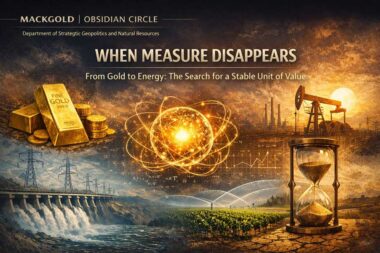
From Gold to Energy: The Search for a Stable Unit of Value
Publication Date: April 30, 2026
Introduction. The Problem of Measurement
Any economic system requires a stable unit of measurement. Without it, comparison of value, investment decision-making, and coordination of economic activity become impossible.
Price exists only where there is a stable measure. If the unit of measurement itself begins to change, values lose comparability.
The modern financial system retains the ability to perform calculations. Payments are executed, markets function, obligations are fulfilled. However, the question increasingly arises regarding the precision of the scale itself.
The problem is not in the functioning of money, but in its ability to serve as a measure.
Historical Forms of Measure
At early stages of societal development, physical resources served as measures. Grain, livestock, and other basic assets functioned simultaneously as wealth and as units of measurement.
With the development of trade, societies transitioned to metals. Gold and silver provided a universal scale due to the stability of their properties and the limitation of their supply.
Metals enabled the creation of a system in which value did not directly depend on political decisions.
In the 20th century, a transition to symbolic currencies occurred. Money ceased to be a carrier of value and became its representation.
This introduced flexibility into the system, but simultaneously led to the loss of an external anchor for measurement.
Loss of Invariance
The key property of any measure is invariance over time. A unit must preserve comparability between past and future.
If the quantity of money increases faster than the volume of real goods, the same nominal value begins to represent different amounts of resources.
Under such conditions, price ceases to be an accurate characteristic of value and becomes a reflection of the state of the monetary system itself.
The economy continues to function, but its measurement precision declines.
Gold as a Transitional Measure
In conditions of declining stability of the monetary unit, gold serves as an external reference point.
The metal retains its physical properties, its supply is limited, and its value does not depend on the liabilities of a specific issuer.
Therefore, during periods of instability, gold is used as a means of value comparison.
However, gold cannot serve as a universal measure in a modern economy.
Its nature is associated with accumulation rather than process. It captures value as a stock, but does not reflect production structure, technological complexity, or differences in cost formation.
As the economy becomes more complex, the need arises for a unit linked not to storage, but to transformation.
Gold retains its role as a transitional element connecting the financial system to physical reality, but does not fully define it.
Energy as a Fundamental Unit
All economic activity is, in essence, the transformation of energy. Production, transportation, construction, and information processes all require energy input.
In this sense, energy represents the universal physical foundation of the economy.
Unlike money, it cannot be created arbitrarily. It is governed by the laws of physics and constrained by available resources.
However, energy is not a homogeneous economic quantity. Different forms of energy possess different capacities to perform useful work, require different infrastructures, and involve different transformation losses.
Physical universality does not imply full economic comparability.
Nevertheless, it is through energy that it becomes possible to describe processes, not merely record their outcomes.
Thus, energy can be considered not as an ideal measure, but as a fundamental level of measurement linked to the real transformation of resources.
Water and Time as System Constraints
The economy does not exist solely within an energy dimension.
Water determines environmental stability. It constrains agriculture, industry, and territorial development.
Time determines human participation in the economy. Any resource ultimately involves an expenditure of human time.
These parameters are not variables within the system — they define its boundaries.
Thus, three fundamental constraints emerge:
energy — capacity for production
water — limit of sustainability
time — limit of participation
They do not depend on financial mechanisms and cannot be altered through monetary expansion.
They define the real limits of economic activity.
Synthesis. A Multi-Level Structure of Measurement
The modern economy will not abandon money. Symbolic systems remain necessary for calculation, contracts, and coordination.
However, their role is shifting.
Money performs the function of accounting.
Gold performs the function of stabilization.
Physical parameters perform the function of measurement.
A multi-level structure emerges, in which each level serves its own purpose.
Attempting to use a single level as universal leads to distortion of the entire system.
Measurement precision is restored not by replacing money, but by re-establishing hierarchy.
Conclusion. Return to Boundaries
The transition to new conditions does not constitute a crisis in the traditional sense. It is a process of adaptation to inherent constraints.
Any complex system ultimately operates within the fundamental laws of matter. The economy is no exception.
Value is determined not by what can be declared, but by what cannot be reproduced arbitrarily.
In this context, gold, energy, and other physical parameters are not alternatives, but different levels of a single system.
When measure loses stability, the system returns to its foundational constraints.
MACKGOLD | OBSIDIAN CIRCLE
Department of Strategic Geopolitics and Natural Resources
April 30, 2026